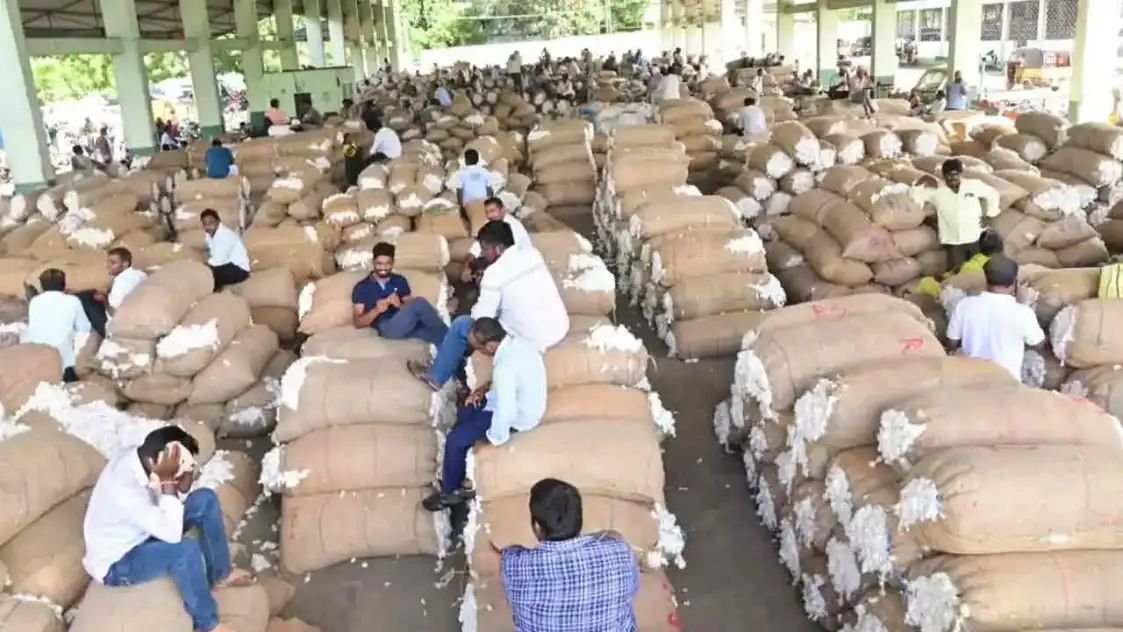
Warangal, Oct.13 : In a major development for the region’s agricultural trade, cotton often termed ‘white gold’ reached a record price of ₹9,060 per quintal at the Warangal Enumamula Agricultural Market, marking the highest rate recorded so far this season. The peak price significantly surpassed the Minimum Support Price (MSP) of ₹8,667 per quintal set by the government, creating a stir among market circles. Out of 3,157 bags of cotton brought to the market on Monday, traders purchased the produce in the range of ₹5,000 to ₹9,060 per quintal depending on quality. Trader competition peaked when J. Sampath Reddy, a farmer from Keshapuram village in Rayaparthy mandal, secured the season’s record ₹9,060 price for his 13 bags of high-quality cotton.
Despite the headline-grabbing prices, ground reality paints a dismal picture for the farming community as severely reduced yields have wiped out potential profit margins. El Niño-induced rainfall deficits during critical crop growth stages, coupled with severe pest infestations, led to boll damage and reduced overall production per acre. Furthermore, steep surges in investment costs—including seeds, fertilizers, chemical pesticides, labor charges, irrigation, and harvesting expenses mean that net returns for farmers remain extremely low despite high market rates. Moreover, officials clarified that the top price applies only to premium-grade cotton with optimal moisture content, leaving average farmers unable to command similar rates.
The surging private market prices have also sparked fresh debate over the necessity and operational role of Cotton Corporation of India (CCI) procurement centers. While private traders are currently outbidding the official MSP to secure limited supplies of quality produce, agricultural experts emphasize that private dominance offers only temporary relief against systemic crop losses. Farmers have urged the government to implement robust measures to reduce cultivation overheads, manage pest threats, and offer comprehensive yield-loss protection to ensure long-term agricultural sustainability.
About the Author