
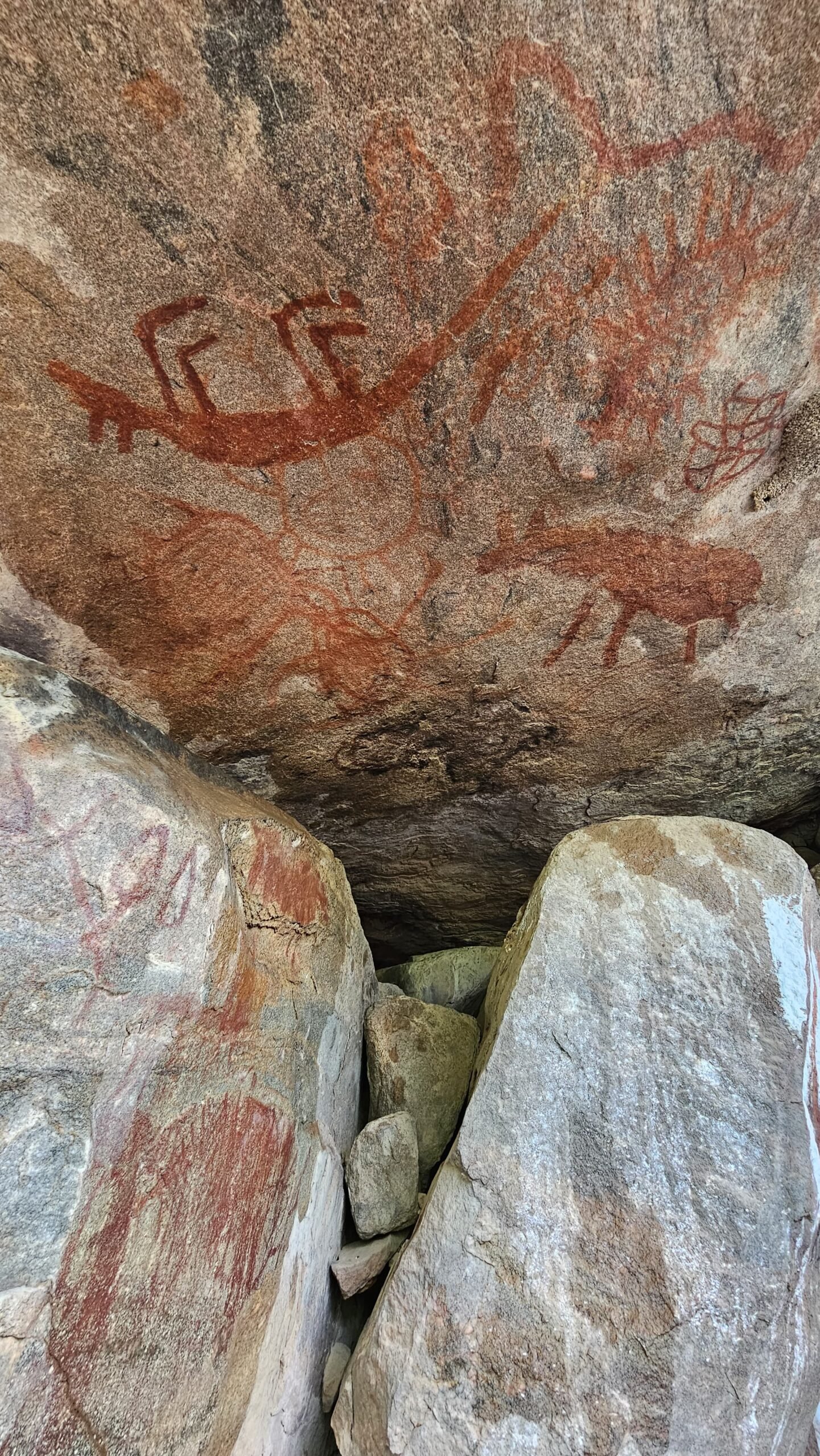
SIRCILLA, JULY 12 : A team of independent researchers from the Matti Foundation has discovered a significant prehistoric rock art site at Maisamma Gutta hillock in Gannevaripalle village, Rajanna Sircilla district. The cave paintings depict animals resembling kangaroos and echidnas—species currently native only to faraway Oceania—alongside rare depictions of a rhinoceros.
Led by archaeology researcher Reddy Ratnakar Reddy, the team scaled the hillock, located 407 meters above sea level. Beneath an eastward-facing rock shelter, they identified numerous drawings rendered in light and dark red pigments. The primary attraction is a profile drawing of a grazing kangaroo, featuring a long, thick tail and a single visible eye. The shelter ceiling also features a spiky echidna and a dark-red rhinoceros, an animal rarely seen in Indian rock art outside of Central India’s Bhimbetka caves.
Based on overlapping paint layers and microlithic stone tools discovered at the site, researchers estimate the earliest drawings date back to the early Mesolithic period around 10,000 BCE. Other geometric drawings, including a mysterious circle and star-like depictions near sharpening grooves, are believed to belong to the Neolithic era around 5,000 BCE.
The Matti Foundation has urged the state government and the archaeology department to immediately step in, secure the area, and conduct a scientific evaluation. The group warned that the ancient art faces an imminent threat of destruction from local religious activities. They noted that prehistoric art at the nearby Laxmapeta hillock was permanently ruined when locals painted over the cave walls with white lime coat, and requested immediate protection for the Gannevaripalle site.
End…….
Key words : Sircilla, Prehistoric, Rock-art, Kangaroo, Rhinoceros, Echidna, Painting, Cave, Mesolithic, Neolithic, Archaeology, Foundation, Ratnakar, Hillock, Discovery, Pigment, Tool, Ancient, Conservation, Artifact
About the Author